The Problem — Your Database Has No Backup Strategy
You're running PostgreSQL without a backup strategy, and you know that's a ticking clock. One accidental DROP TABLE, one corrupted volume, one server failure — and months of data vanish. Redis is even worse: default config stores everything in memory with no persistence guarantee.
You've been meaning to set up pg_dump cron jobs, configure WAL archiving, test restores, and tune PostgreSQL for production. But between feature work and firefighting, "database reliability" stays on the backlog indefinitely.
What This Stack Does For You
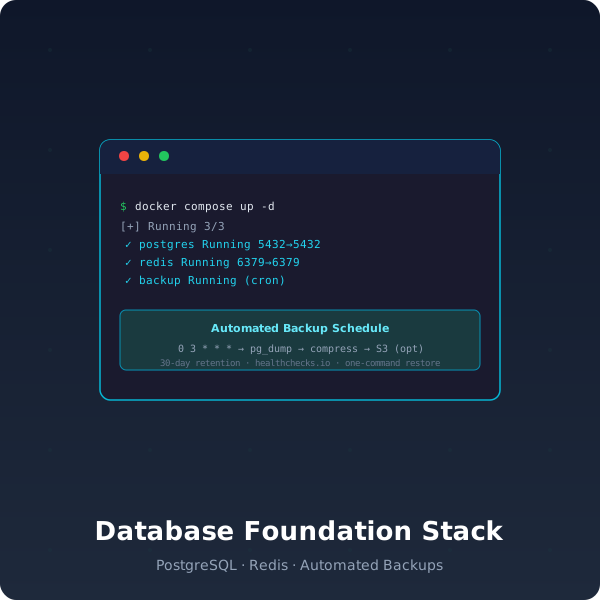
Deploy a production-grade PostgreSQL + Redis stack with automated daily backups, 30-day retention, and optional S3 off-site sync — in one command. Your databases survive failures without you thinking about them.
What You'll Be Able To Do After Deploying
- Never lose data again — Automated daily
pg_dumpbackups with compression and 30-day retention, plus S3 off-site sync so a server failure doesn't mean data loss - Restore in one command — Tested restore scripts that bring your database back from any backup point, no spelunking through old dumps
- Run PostgreSQL tuned for your hardware — Production settings for shared_buffers, WAL compression, autovacuum, and logging — optimized for 2-4GB RAM out of the box
- Redis with crash-proof persistence — AOF + RDB persistence configured so a restart doesn't wipe your cache and session data
- Know your backups work — Every component is documented so you can verify backups are running and restores are possible, not just hope they are
Why This Saves You Hours
Setting this up from scratch means:
- Config research: Learning PostgreSQL tuning parameters, WAL settings, and autovacuum thresholds — then testing them
- Scripting: Writing
pg_dumpscripts, compression pipelines, S3 upload logic, and rotate-old-backups cleanup - Redis persistence: Figuring out AOF vs RDB tradeoffs, then realizing default config doesn't survive container restarts
- Testing restores: The step everyone skips until they actually need it and discover their backups are corrupt
This stack gives you a battle-tested foundation. One docker compose up and you have production-grade databases with backups that actually work.
What You Get
- docker-compose.yml — 3 services: PostgreSQL (tuned for 2-4GB RAM), Redis (AOF+RDB persistence), Backup (cron-based pg_dump)
- PostgreSQL config — Production tuning: shared_buffers, WAL compression, autovacuum, logging
- Backup & restore scripts — Automated daily dumps with compression, S3 sync, and one-command restore
- .env.example — All environment variables documented
- README.md — Architecture diagram, quick start, production checklist
Requirements
- Docker Engine 24+ with Docker Compose v2
- 4GB RAM minimum, 8GB recommended
Your Outcome
5 minutes from now, you'll have PostgreSQL and Redis running with production tuning, automated daily backups, and one-command restore. No debugging, no forum-scrolling, no "I'll set up backups later" — because later is now.